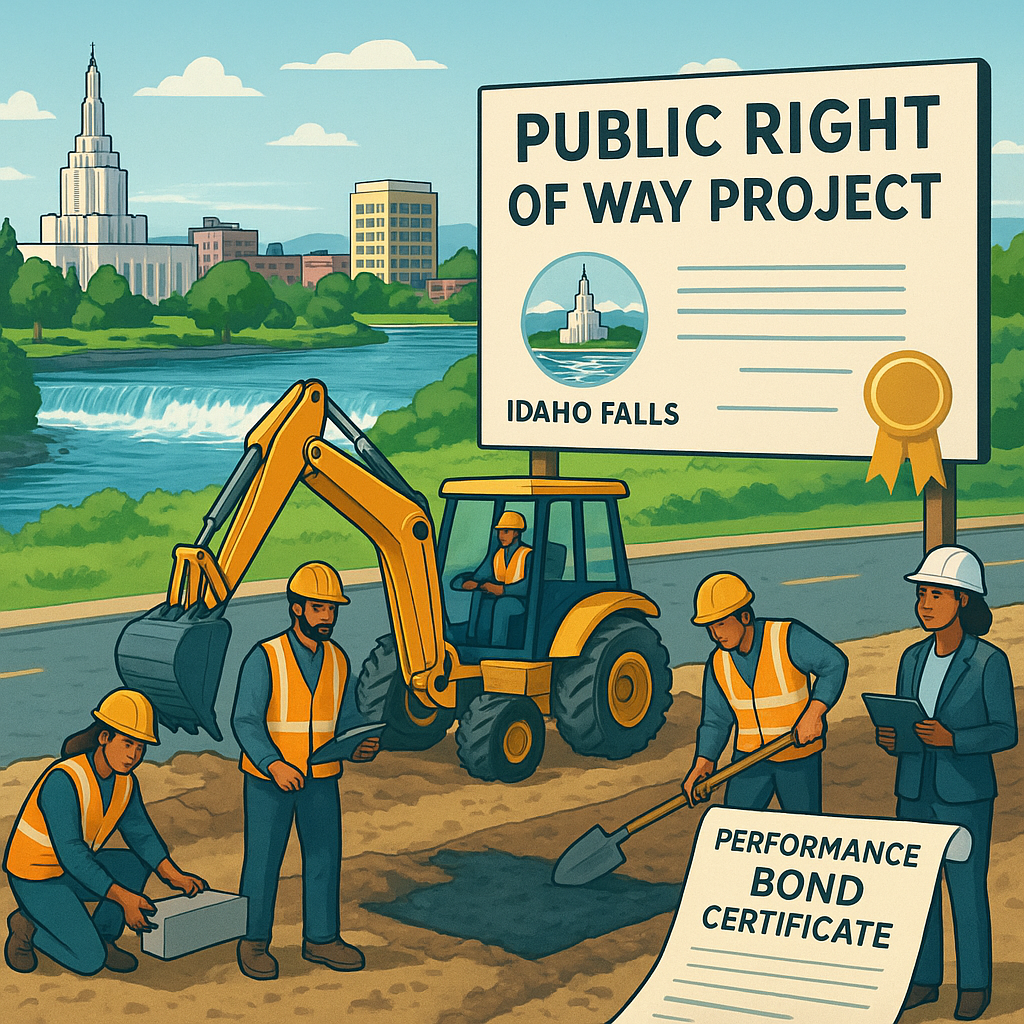
If you’re a contractor looking to dig, install utilities, or build anything near a street or sidewalk in Idaho Falls, you’ve probably heard the term “right of way” tossed around. It sounds a little formal, almost like something only big engineering firms need to worry about. But here’s the thing: if your project touches the strip of land that runs alongside a public road—the right of way—you need to follow city rules. And in Idaho Falls, that means securing the proper license and a performance bond.
This guide breaks it all down in plain English. No legal jargon, no confusing flowcharts. Just a friendly conversation about what’s required, why it matters, and how you can go from confused to compliant without pulling your hair out.
What Exactly Is the Public Right of Way in Idaho Falls?
Let’s start with a simple mental picture. Imagine a neighborhood street. The pavement you drive on is only part of a larger strip of land owned by the city. This strip usually includes the sidewalk, the grassy area between the sidewalk and the curb, and sometimes even a portion of what looks like a homeowner’s front yard. That entire zone is the public right of way.
Think of it like a shared hallway in an apartment building. You might walk through it every day, but you can’t just knock down a wall or start storing your stuff there without permission. The city manages this “hallway” to keep everyone safe, protect underground utilities, and make sure future access isn’t blocked. Whenever a contractor needs to work in this space—to repair a water line, lay fiber optic cable, install a new driveway approach, or even fix a broken curb—the city requires a license and a bond. It’s their way of saying, “We trust you to do the job, but we also need a financial safety net just in case.”
Why a Contractor License and Performance Bond Go Hand in Hand
So why can’t you just pull a standard building permit and start digging? That’s a question many experienced contractors ask. The answer lies in the special responsibility that comes with working in a shared public space. A typical building permit covers work on private property—your client’s house, their backyard deck, or a commercial lot. The right of way is different because it belongs to everyone. If something goes wrong, the city, not just a single homeowner, has to fix it.
Here’s where the performance bond enters the picture. A performance bond is like a financial promise. You’re telling the city, “I will complete this job according to your standards, and I’ll restore any pavement, sidewalk, or landscaping I disturb.” If the work is subpar, or if you leave a gaping hole that the city has to repair, the bond covers those costs. Without it, taxpayers could be stuck footing the bill for a messy, unfinished project. In Idaho Falls, the Public Right of Way Contractor License and the required bond are a package deal. You can’t get one without the other.
Who Needs This License, Really?
You might be a general contractor who mostly builds homes but occasionally needs to connect a new house to the city sewer line. Or maybe you run a small landscaping company and a client asks you to replace a crumbling retaining wall that inches into the right of way. Even sign installers and tree-trimming services can find themselves under the city’s microscope if their work touches the public strip.
The rule of thumb is refreshingly straightforward: if your tools, equipment, or crew will occupy, dig up, or alter any part of the public right of way, you almost certainly need this license. It doesn’t matter if you’re a one-person operation or a large excavation firm. The city wants to know who is working in their spaces and that they are qualified to do the work safely.
The Step-by-Step Path to Getting Licensed and Bonded
Now that you know the “why,” let’s walk through the “how.” The process might seem daunting at first, but it’s really just a few logical steps. Think of it like assembling a jigsaw puzzle—each piece on its own isn’t complicated, but you need them all to see the full picture.
Step 1: Check Your Basic Requirements
Before you fill out any paperwork, make sure you have a few fundamentals in place. The city will typically ask for proof that you hold a valid Idaho contractor registration at the state level. You’ll also need a current business license from the City of Idaho Falls if your company is based there or conducts substantial work within city limits. Without these foundational documents, your right of way application won’t move forward.
Step 2: Get a Clear Understanding of the Bond Amount
The bond amount isn’t pulled out of thin air. It often correlates with the type and scale of the work you plan to do. For most contractors, the City of Idaho Falls requires a Public Right of Way Performance Bond in a set amount—commonly in the range of $5,000 or $10,000, though larger infrastructure projects might demand more. Always confirm the exact figure with the city’s building or public works department, because bond requirements can change. The key thing to remember is that you’re not paying the full bond amount upfront. You pay a premium, much like an insurance policy, to a surety company. That premium is a small percentage of the total bond value.
Step 3: Secure Your Bond and Gather Your Paperwork
Once you know the required bond amount, reach out to a surety bond agency. They’ll ask about your financial history and business track record. After approval, you’ll receive a bond form. This document is critical—it officially names the City of Idaho Falls as the entity protected by the bond. Along with the bond, you’ll need to complete the city’s right of way contractor license application. Have your state registration numbers, business license details, and proof of insurance (typically general liability) ready to go. Imagine you’re putting together a small folder: application, bond form, insurance certificate, and any requested fee. Double-check that all names match exactly. A typo can cause frustrating delays.
Step 4: Submit Everything and Allow for Processing
You’ll submit your complete packet to the city department that handles right of way permits—often the Public Works or Building Department. Many cities now accept applications electronically, but calling ahead to ask can save you a trip. Processing doesn’t happen overnight. Give yourself a couple of weeks. During this time, city staff reviews your documents to ensure you meet all requirements. Once approved, you’ll receive your Right of Way Contractor License, and you’re officially cleared to apply for project-specific permits within the right of way.
Key Regulations You Can’t Afford to Ignore
Having a license and bond is just the starting line. Once you’re working in the right of way, a whole set of rules kicks in. These aren’t meant to make your life difficult. They’re designed to protect everyone—drivers, pedestrians, your crew, and the buried web of pipes and cables under your feet.
Traffic Control and Safety Requirements
Imagine you’re digging a trench near a crosswalk on a busy street. You can’t just park your truck and start working. The city will require a traffic control plan that follows the Manual on Uniform Traffic Control Devices (MUTCD) standards. This means proper signage, cones, barricades, and possibly a flagger if you’re impeding traffic flow. The goal is to make sure a mom pushing a stroller or a delivery driver can navigate around your site without a scary near-miss.
Underground Utility Locates Are Non-Negotiable
Before you ever break ground, you must call 811 to have underground utilities marked. This free service sends out locators who spray-paint colorful lines on the ground showing where gas, electric, water, and communication lines hide. Even if you’re replacing a tiny section of sidewalk, hitting an unmarked fiber optic line can set you back thousands of dollars and knock out internet service for a whole neighborhood. In the right of way, an accidental strike isn’t just inconvenient—it can lead to license penalties and bond claims.
Restoration Standards: Making It Look Like You Were Never There
This is the part where your bond really comes into play. When you’re done with a project, you must restore the right of way to the city’s standards. Did you cut into the pavement? The repair has to be smooth and sealed. Did you disturb the landscaping strip? You’ll likely need to backfill, compact the soil, and re-seed or re-sod the area. The city will inspect the work. If the repair fails or sinks into a puddle-collecting rut months later, they can call on your bond to hire someone else to fix it. Treat restoration as the closing chapter of your project, one that leaves a positive final impression.
Common Mistakes That Trip Up Even Seasoned Contractors
Let’s be honest, nobody’s perfect. But in the right of way business, some mistakes repeat themselves. Knowing them in advance can keep you out of hot water.
- Assuming the homeowner’s property line is where the fence is. Often, the right of way extends several feet past the sidewalk. Always check the official city maps before you start planning. A friendly conversation with the city can prevent you from accidentally trespassing with an excavator.
- Letting the bond lapse. The license is valid as long as the bond remains active. If you forget to renew the bond, your license becomes invalid the very same day. Set reminders well in advance.
- Skipping the pre-construction site meeting. For larger jobs, a quick walk-through with a city inspector before you dig can uncover potential issues that aren’t obvious on paper. It’s a small investment of time that can save giant headaches later.
- Not notifying nearby residents. While not always a city regulation, courtesy goes a long way. A simple flyer or a friendly knock on the door explaining that you’ll be blocking a sidewalk for two days can prevent angry calls to city hall.
How to Keep Your License and Bond in Good Standing Year After Year
Once you’re licensed and bonded, the annual upkeep becomes part of your business rhythm. Most licenses need to be renewed each year, often around the same time. The city will send a notice, but it’s smarter to track the date yourself. Renewal typically involves submitting a new certificate proving your bond is still active, paying a renewal fee, and confirming your insurance hasn’t expired.
Think of your license as a living document. If your company name changes, or if you expand into a new type of work that requires a higher bond, you need to update the city right away. An outdated license can result in a stop-work order, and that’s a conversation no contractor wants to have with a client.
What Happens If You Work Without the Right Credentials?
It’s tempting to skip the process for a small, quick job. A homeowner might beg you to just “fix the end of the driveway” so they can list their house by the weekend. But the risk far outweighs the convenience. The city routinely inspects work in the right of way, and fines for unlicensed work can be steep. More importantly, if an accident happens—a pedestrian trips over your tools, or a gas line gets nicked—you’ll be personally liable. Without the bond, your business assets and reputation are completely exposed. Playing by the rules isn’t just about following city code; it’s about protecting the company you’ve worked so hard to build.
Bringing It All Together: Your Roadmap to Smooth Sailing
Getting your City of Idaho Falls Public Right of Way Contractor License and Performance Bond might feel like one more hoop to jump through in an industry already packed with red tape. But reframe it. See it as your ticket to bidding on a wider range of jobs—the ones that pay well and build your reputation as a contractor who does things the right way. The process is clear: register with the state, secure your bond, apply with the city, and then work safely and responsibly.
Do you have a project coming up that will touch a sidewalk, curb, or street edge? Start the licensing conversation early. Call the city, ask about the current bond amount, and get your paperwork in order. You’ll walk onto the job site confident and fully compliant, with no knot of worry in your stomach about a surprise visit from a code officer. And when the work is done and the restoration is seamless, your client—and the city—will know they made the right choice by hiring you.