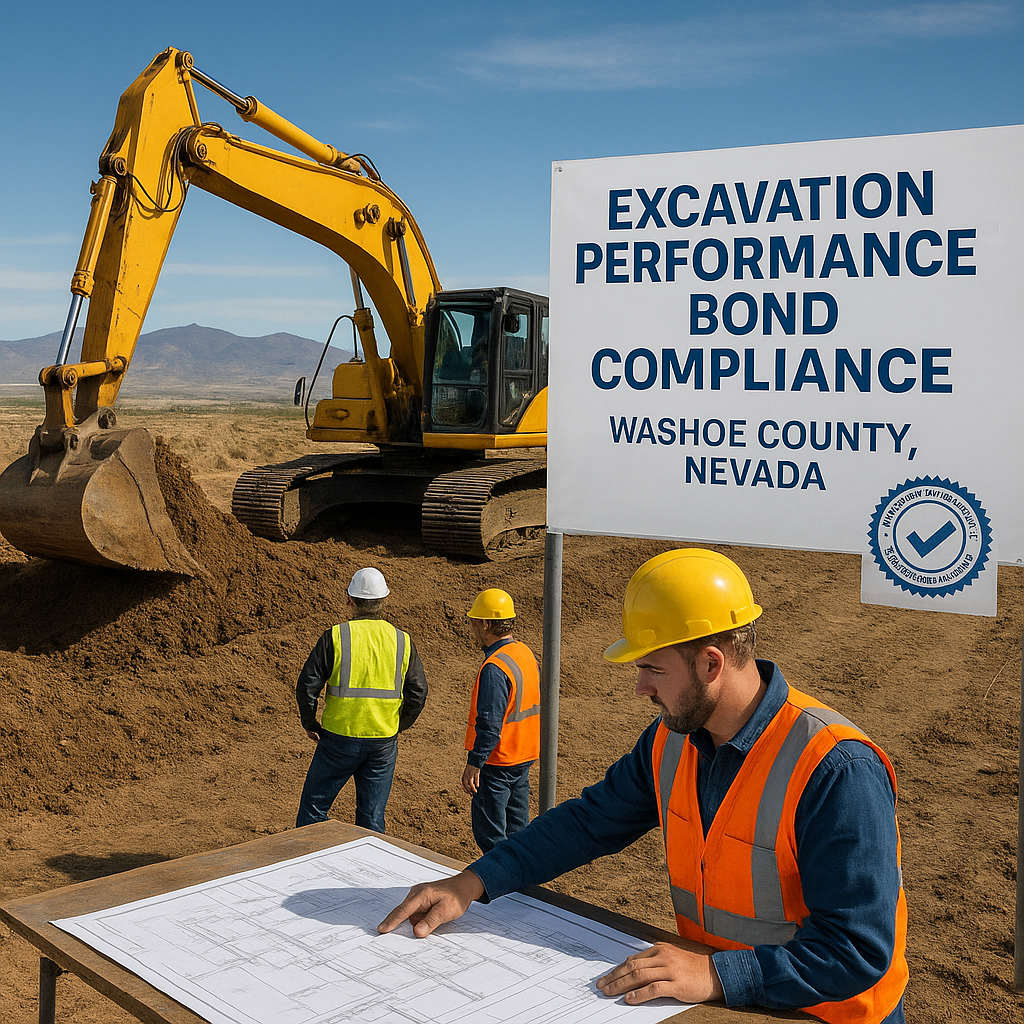
Picture this: You’re an excavation contractor in Reno, Sparks, or anywhere across Washoe County. You’ve just landed a promising project — maybe it’s trenching for a new utility line, grading a site for a commercial building, or digging a foundation in the foothills. Everything looks great until the county hands you a requirement that feels like a curveball: an excavation performance bond. If you’ve never dealt with one before, or if you’re simply trying to understand why it keeps popping up, you’re in the right place. Let’s break it all down in plain, friendly terms.
What Exactly Is an Excavation Performance Bond?
Think of a performance bond as a promise with a financial safety net. In simple language, it’s a three-party agreement: you, the excavation contractor (the principal), the County of Washoe (the obligee), and a surety company (the bond provider). The bond guarantees that you’ll complete the agreed-upon work according to the county’s rules, your contract, and local codes. If something goes sideways — say the project is left unfinished, or the work doesn’t meet standards — the bond kicks in to make things right. It’s not insurance for you; it protects the county and, by extension, the public.
Why Would Washoe County Require This Bond?
You might be wondering, “Why does the county care so much about my excavation work?” The answer lies in public safety and infrastructure integrity. When you dig, grade, trench, or move earth within county jurisdiction, your work can affect roads, drainage, utilities, and neighboring properties. A partially completed excavation site left unsecured could create hazards, erosion, or expensive damage. The performance bond gives Washoe County a financial guarantee that, even if your company hits an unexpected crisis — financial trouble, equipment breakdown, or closure — the project won’t be abandoned without recourse.
In Washoe County, specific permits for excavation, grading, or right-of-way work often trigger the bond requirement. The exact dollar amount, whether it’s $5,000, $25,000, or a custom figure, is typically based on the project’s scope and the potential risk to public infrastructure.
How Do Excavation Performance Bonds Work in the Real World?
Let’s walk through a typical scenario. Say your company, Peak Grade Excavation, wins a contract to prepare a pad for a new medical office near South Meadows. The county issues a grading permit with a condition: you must post a $20,000 performance bond. You contact a surety provider, fill out an application, and undergo a quick underwriting process. Once approved, you pay a small percentage of the bond amount — usually between 1% and 3% for well-qualified contractors — and the surety issues the bond. You submit that bond to Washoe County, and the permit moves forward. Happy days.
If you finish the work correctly, the bond simply expires or is released. The county never touches the bond. It’s only if you default or fail to meet obligations that the county files a claim. At that point, the surety investigates. If the claim is valid, the surety may pay out up to the bond’s full amount, and then they’ll seek reimbursement from you. That’s a key distinction: you’re ultimately on the hook. The bond is a guarantee, not a free pass.
Is This Different From a Contractor License Bond?
Yes, and the difference matters. A contractor license bond, often required by the Nevada State Contractors Board, guarantees that you’ll follow state laws and codes across all your work. It’s a blanket requirement to keep your license active. An excavation performance bond is project-specific and focused on the physical completion of a particular job for Washoe County. You might need both — the license bond to operate legally in Nevada and the performance bond to pull a specific county permit. They serve different pockets of protection.
Who Needs This Bond in Washoe County?
The short answer: almost any excavation contractor performing work that disturbs the ground and requires a county permit. This includes, but isn’t limited to:
- Site grading and earthmoving for new construction
- Utility trenching within county right-of-way
- Excavation for foundations, ponds, or retaining walls
- Roadway or sidewalk repair that involves cutting into existing pavement
- Drainage channel construction or modification
If you’re uncertain whether your project triggers the bond, reach out to Washoe County’s Community Services Department or Engineering Division. A quick call can save you from permitting delays. The county’s goal isn’t to make your life difficult — it’s purely about compliance and safeguarding the community’s investment.
Benefits Beyond the Permit
Okay, so posting a bond feels like just another hoop to jump through. But there’s a silver lining. Being able to secure a performance bond signals to prime contractors, developers, and municipal clients that you’re financially stable and credible. It’s a trust badge. Many larger projects — including federal, state, and county work — demand bonding capacity. Starting with small Washoe County bonds builds your track record, which can help you later qualify for bigger contracts that require substantial bid and performance bonds.
Additionally, the bonding process itself can help you fine-tune your business. Sureties often review your financial statements, project history, and management practices. Their scrutiny, while sometimes nerve-wracking, can highlight areas for improvement you might have overlooked — like cash flow management or contract documentation. Think of the surety as an unofficial coach pushing you to sharpen your game.
What Affects the Cost of Your Excavation Performance Bond?
The premium you pay hinges on a few key factors. The bond amount set by Washoe County is the first piece. The second is your personal and business credit score. Strong credit often means a premium as low as 1% of the bond amount. If your credit has a few bumps, don’t panic — approval is still possible through specialty surety markets, though the rate may inch up toward 3% or more. Other factors include your company’s financial liquidity, years of experience, and history of completed projects (especially without claims).
Here’s some quick math: if the county requires a $15,000 bond and you qualify for a 2% rate, your out-of-pocket cost is just $300. Compare that to the value of the contract and the peace of mind it provides everyone involved — it’s a manageable business expense.
How Long Does It Take to Get Bonded?
For a straightforward small-to-medium bond, the process can take as little as 24 to 48 hours from application to issuance. If your financials are complex or you need a larger bond, give yourself a week. The key is having your paperwork ready: business financial statements, a current work-in-progress schedule, and personal financial information if you’re a smaller operation. Working with a surety broker who understands Washoe County requirements can speed things up considerably.
Common Pitfalls and How to Avoid Them
Even seasoned contractors stumble over bond-related issues. Let’s look at a few potential traps:
- Assuming the bond covers all mistakes. It doesn’t. A performance bond is not a substitute for general liability insurance. If you accidentally hit a water main and cause a flood, your liability policy should respond to the property damage. The bond only steps in if you fail to perform the excavation work as promised.
- Ignoring the bond’s expiration or renewal terms. Some bonds extend until the county officially accepts the completed work. If a project timeline stretches, you might need to extend the bond. Stay in communication with the county to avoid a lapse.
- Treating the bond as a one-and-done task. As your business grows, your bonding capacity can grow with it. Regularly review your surety relationship so you’re not caught off guard when a bigger opportunity comes along.
Real-Life Example: Excavation on a Hillside Subdivision
Imagine a contractor hired to clear and grade several lots in a Washoe County subdivision perched on a slope. The county’s requirement: a $30,000 performance bond to ensure proper drainage and slope stability. Halfway through, the contractor loses a critical piece of equipment and cash flow tightens. The project stalls, leaving exposed soil vulnerable to winter storms. Because the bond is in place, the county can file a claim, hire a replacement contractor, and stabilize the site before a mudslide damages homes downhill. The original contractor faces a claim payout and damage to his reputation, but the community stays safe. This scenario illustrates why the county insists on bonding — it’s a vital safety net that protects everyone downstream, literally and figuratively.
Steps to Take Before You Apply
Ready to tackle your excavation performance bond? Here’s a simple checklist:
- Confirm the exact bond amount and form required by Washoe County. Don’t guess — ask for the specific bonding directive.
- Gather your financial documents. At minimum, you’ll likely need recent business bank statements, a balance sheet, and a profit-and-loss statement. If you’re a sole proprietor, have your personal tax returns handy.
- Compile a list of your completed excavation projects. Include references and contract values if possible.
- Contact a surety bond professional. Independent agents often work with multiple surety companies, giving you more options.
- Discuss project timelines and any unusual requirements. The more the surety knows, the smoother the quote.
Frequently Asked Thoughts (You’re Probably Thinking These)
Can I use the same bond for multiple jobs?
Usually, no. Most Washoe County excavation performance bonds are issued for a specific permit and project. Once that job wraps up and is approved, the bond is released. If you have multiple concurrent projects, you’ll need a separate bond for each unless the county agrees to a blanket bond arrangement — which is rare for small to medium operations.
What if I work outside Washoe County too?
Great question. If you take a job in Carson City, Douglas County, or elsewhere in Nevada, the local jurisdiction may have its own bonding requirements. While the concept is the same, each county sets its own rules. You’ll need separate bonds tailored to each obligee. Always verify before you start digging.
Is the bond refundable once the job is done?
The premium you pay for the bond isn’t refundable — that’s the cost of obtaining the guarantee. Think of it like paying for any other service: the surety took on risk for the duration, so that fee stays with them. The bond itself isn’t cash you put down; it’s a line of credit, in a sense. Once the county releases the bond, your obligation ends, but you don’t get a refund on the premium.
Making the Process Smooth and Stress-Free
At the end of the day, an excavation performance bond for Washoe County is just one piece of the puzzle when you’re doing what you love — moving earth and building Nevada’s future. Approach it with a clear understanding, a prepared application, and a good surety partner, and it rarely becomes a stumbling block. If you treat the bond as a tool for building trust rather than a bureaucratic hurdle, you’ll find that it opens doors to more lucrative, stable projects.
So the next time the county mentions “performance bond,” you can nod with confidence. You know what it is, why it’s needed, and how it protects everyone involved. And who knows? That small bond today might be the stepping stone to landing tomorrow’s landmark excavation contract.